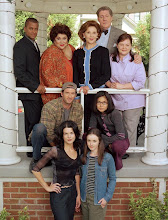
Yes, I realize I haven't completed my follow up post about The Metamorphosis yet (I just haven't gotten around to getting the quote I need from that episode of Gilmore Girls!), but I am about two-thirds of the way through book number 6:
The Bell Jar by Sylvia Plath
Lorelai, surprised at Rory's choice to go to a Chilton party one evening, makes a crack that staying home and reading The Bell Jar would have the same effect on her. I decided to find out what she was refering to. So, jump on board and read about Esther losing her mind! =)
Happy reading!
Showing posts with label Season 1. Show all posts
Showing posts with label Season 1. Show all posts
Thursday, August 4, 2011

Monday, May 16, 2011
Book Number 5
Alright! Now That I've finally finished reading all books from the very first episode of Gilmore Girls, I am going to break the pattern and skip around as I please. I think this will help with the speed of the blog - allowing me to pick what seems most appealing at the time. I have also broken another pattern with this post already - usually I open with a quote from the episode that introduces the book I have chosen to read, but tonight I decided to keep watching the show chronologically (I'm currently watching Season 2), and didn't feel like skipping back to Season 1 to get the quote. So for now you'll have to be satisfied with me just giving you the title straight out:
The Metamorphosis by Franz Kafka
The Metamorphosis is actually a short story, and a very quick read. I read it once in college and found it kind of humorous, so decided it would be a good book to take with my on my recent weekend getaway (home!). It's so short I actually finished it before my flight was over, and still had time for a nap - so get reading, because I'm already ready to post my thoughts on it!
I promise I'll include the quote from the episode in my next post.
Saturday, May 7, 2011
Book 4 Review - Madame Bovary
I finished Madame Bovary at least two weeks ago, I've just been lazy with the posting a blog thing.
The book was really a quick read; I was surprised how quickly the pages flew by during my 30 minute lunch break at work each day. I found parts of it interesting, and the writing was well done, but honestly, I didn't care for the main character. The main reason most likely being that Madame Bovary was never satisfied with her life! Ever! It seemed like she had a great upbringing - her father tried to give her the best by sending her off to be educated in the city where she was able to study music and art which was considered a luxury in her time. Maybe that was what sparked her unhappiness...she was able to live a life others dreamed of, and then she went back to her family's farm. Perhaps she felt that the things she had learned weren't appreciated or were just useless back in a small town. I don't know. I honestly don't understand people who can't find anything positive in their living situation.
Madame Bovary married a young widower, had a daughter (who was raised mainly by a nurse), and lived a comfortable life yet constantly dreamed of having more. More of what... I felt was never really defined. She wanted every fantasy and daydream to come true. Her devoted husband caved to her every whim, and even relocated his business as a health officer to another town when he thought her health/nerves were suffering from boredom and whatnot.
Ultimately I found the Madame to be plain selfish and I was almost relieved to see her put an end to things. I didn't feel terrible for the husband either - it was like he ignored what was right in front of his eyes, and was complacent, or rather apathetic with his life. In a way he was the exact opposite of his wife. She was never satisfied, and he was overly indifferent. Their daughter wasn't a major focus in the book, but in the end I felt the worst for where she ended up.
What was this book trying to teach or prove? No idea. But hopefully it inspires people to look for the little joys in their lives even when things aren't going exactly the way we want them to. Better yet, I hope it shows that infidelity ruins families.
And I still have no idea why the color blue was mentioned nearly every other page.
Sunday, April 3, 2011
Book Number 4
Dean: "After school you come out and you sit under that tree there, and you read. Last week it was Madame Bovary, this week it's Moby Dick." Madame Bovary by Gustave Flaubert Yes, this book is mentioned at the same time as Moby Dick, during the awkward getting-to-know-you scene with Rory and Dean in the pilot episode. I have no expectations for Madame Bovary, which is good I think - since having expectations for Moby Dick made me impatient while reading. I hadn't heard of Madame Bovary before (that I can remember), so I'm coming at this book with a clean slate. Truthfully, I've already started reading, and it's going MUCH quicker than the last book, so if you want to read it with me you better pick it up quickly! I'm already nearing the halfway point! A new friend of mine saw me reading before a class I'm taking and mentioned that she had studied French, and discussed part of Madame Bovary in one of her classes. She said that another student had pointed out the repetition/frequent references to the color blue throughout the book. I hadn't conciously noticed up to that point, but ever since I have seen the color blue mentioned about every other page. I may want comments from those who read it about why this is in my next review post... I haven't figured out the reasoning yet. Who's in on this one?
Sunday, March 27, 2011
Book 3 Review - Moby Dick
(For some stupid reason I can't get this post to separate into paragraphs when I hit publish - even though I can see the paragraphs when I'm in edit mode!! So frustrating! So for now, I'll alternate colors to show different paragraphs... grr. If anyone knows how to fix this issue, let me know!) I finished Moby Dick about a week and a half ago, but to be honest I was so tired of the book at the time I needed a break from it. Hence the delay in blogging about it. I don't anticipate this post being terribly long, either. So - here it goes... I wish I had done a little more research on the book before I started reading it so I knew what to expect. I have a friend who does that with movies; she'll sit down and the start the movie without knowing much about it, but about 15 minutes in she has her computer out and she's looking up plot summaries and character info on different movie websites. I personally don't like to know the outcome of a movie/book, etc. before I watch/read it because I think it spoils the ending, but in the case of Moby Dick I really think knowing more details of the book before hand would have helped me get through it easier, and here's why: First of all Herman Melville seems to go off on tangents a lot in the book. I guess it's important to know a little about the set up and design of a whaling ship since that's where the majority of the story takes place, but I felt like the author detailed more than what was necessary. There were also such chapters as "The Whale as a Dish," "The Right Whale's Head - Contrasted View," and "Measurement of the Whale's Skeleton" that just seemed to drag on with facts and details that in the long run didn't contribute much to the action of the book. I read some articles online after I finished Moby Dick; one of which said: "Moby-Dick contains large sections—most of them narrated by Ishmael—that seemingly have nothing to do with the plot but describe aspects of the whaling business. Melville believed that no book up to that time had portrayed the whaling industry in as fascinating or immediate a way as he had experienced it. Early Romantics also proposed that fiction was the exemplary way to describe and record history, so Melville wanted to craft something educational and definitive." So, while writing history into fiction seemed to be fashionable at the time, I think Melville should have separated the history from the fiction. Maybe you disagree, and that's okay, but the history was incredibly boring to me. Probably because I'm not interested in whaling. Second - the white whale didn't show up until page 495. Yep. Four hundred and ninety five. Out of 521 pages. I thought there would be a lot more about the title character throughout the book, but I was definitely wrong. This was mostly thanks to the tangents explained above. Okay, enough complaining. On to what I DID get out of it; my own conclusions and such. Not long after Captain Ahab actually enters the scene (the narrator talks about him a bit before he actually appears) you learn about his quest - to hunt the white whale who had taken off his leg on a previous whaling venture. It didn't matter to him that the whaling ship didn't belong to him and that its purpose was to turn a profit on the voyage; revenge was all that mattered to Ahab. He quickly rallies the majority of the crew to join him on this quest (not that they could back out - having already been on the ocean some time). By the time Moby Dick was finally sighted and the crew began its three-day chase of the whale I swear I was starting to feel like Ahab in a way. I could feel Ahab's anticipation building; he had been searching for this whale for years. It was go time! I was surprised how fast the final chapters flew under my fingertips. After all the long, drawn-out descriptive chapters beforehand these final chapters were short and to the point. I was kind of disappointed - wasn't this supposed to be an epic battle? It was over so quickly. **This next part will reveal the ending of the book, so if you plan to read it yourself, you should probably skip it. As I read about Ahab being strangled and dragged from the small boat by his own whaling line that he had plunged into Moby Dick's side, and about the fate of the whaling ship and all but one of its crew members as it was sunk by the force of the white whale plowing into it, my thoughts turned deeply inward; I couldn't help but think about my decisions in life and draw some life lessons from the book: What are the goals and causes I am aiming for? Have I chosen them wisely, or am I making my decisions based on emotion and revenge like Ahab did? Are my causes worth fighting for? Are my actions positively influencing others, or are they the types of decisions that will ultimately drag me down and take others with me? Is the end result worthy of the battle?
Monday, October 18, 2010
"I Just Love To See You Happy."
Ah, Luke, you've done it again. Every time I hear that line come from you in the final episode of Season Seven I wish I were Lorelai standing in front of you on the damp street in front of your diner.
So... you may have gathered that I just finished watching the entire series (again). I think I watched it in record speed this time, but goodness, what a great way to unwind after a long day at work, right? Get home, hang up the jacket, cook a nice meal, and get situated in front of a cozy episode or two of the lovely Gilmore Girls. Life is grand sometimes!
You may also be happy to learn that I am once again making progress on Moby Dick; I slacked off there for a good chunk of time since, well, the book was really slow there for a while. But I have gotten back in the habit of pulling out the book while on my lunch break and reading while I munch away. Today I finished chapter XXXVIII or, 38 (yes, the chapters are in Roman Numerals in the book). This puts me at page 162 of 521.
At this point Captain Ahab has physically entered the narrative, and is no longer a figure of Ishmael's thoughts - pieced together from stories from shipmates and personal interpretations of this presence (or lack thereof). I kind of like Captain Ahab's character so far. The book seems to be teasing me with him... he is described by members of the crew, and just recently the book delivered a chapter written as if you were in Ahab's thoughts, yet, you know there is SO much more to this character than is being described. I think he will get more interesting/entertaining in the next 50 pages or so.
Is (or was) anyone reading along? Did you finish months ago while waiting patiently (or impatiently) for me to catch up? Or did everyone hear the name Moby Dick and just say "pass"? Any time I have mentioned that I'm actually reading Moby Dick I am met with questions like: "why on earth would you actually read it?" or with comments like "I started reading that book once, but..." Think of me what you will for taking on this endeavor, but I promised to read EVERY work of literature mentioned in the Gilmore Girls, and no matter how long it takes, that I will do!
And that my friends, will make me very happy.
Wednesday, June 9, 2010
Book Number Three
Dean: "So how are you liking Moby Dick?"
Rory: "Oh, it's really good."
Dean: "Yeah?"
Rory: "Yeah, it's my first Melville. I mean, I know it's kind of cliche to pick Moby Dick as your first Melville but... hey, how did you know I was reading Moby Dick?"
Moby Dick by Herman Melville
I must confess this is also my first Melville. I've already started the book, but I can already say that this one is going to take me some time. I started reading it at least a week ago yet I'm only in chapter three. Sad. It seems to be a slow start, and there are a lot of words and phrases that I am unfamiliar with so I end up re-reading paragraphs just to understand what's going on. If I'm not careful my mind starts wandering and I have to re-read an entire page. I REALLY hope it picks up, and soon!
The other day I was on the phone with a friend who loves to read and I mentioned that I had started Moby Dick. She asked, "You're reading that book by choice?" She said she'd only read it if she had to for an assignment. Maybe she had to already. Anyway, even though the book hasn't quite caught my interests yet and has gotten one negative review from a friend I'm still determined to get through it; maybe even enjoy it!
Tuesday, June 8, 2010
Book 2 Review - The Little Match Girl
The opening episode of Gilmore Girls makes a point of setting up the awkward and estranged relationship between Lorelai and her parents - Richard and Emily.
When Rory gets accepted to Chilton (a prep school) mid term Lorelai is faced with the large sum required as an enrollment fee along with the first term's tuition, or Rory cannot accept the open spot. Not wanting Rory to know that money for school is an issue, Lorelai discusses ideas with her friend and co-worker Sookie who suggests asking Lorelai's well-to-do parents for help. Lorelai refuses to even accept the idea (having unhappily left home at 16 to live her own life away from Richard and Emily)... until she realizes that there is no other option.
Semi unwillingly, Lorelai visits her parents (who each make a crack about Lorelai showing up on a day that isn't a holiday), explains the situation and asks for a loan. To her surprise Lorelai's parents agree. Seizing an opportunity Emily Gilmore requests that she take on an active role in Lorelai and Rory's lives by having mandatory Friday night dinners and weekly phone calls about Rory's schooling and updates about their lives until the loan is repaid. Seeing the strings attach themselves to the situation, Lorelai only asks that the loan remain a secret from Rory.
The next evening Lorelai and Rory find themselves standing on the front porch of the Gilmore home staring at the door. This is where Rory references The Little Match Girl.
***
In the story of The Little Match Girl we learn about a poor girl who is out in the street unsuccessfully trying to sell matches to please her unloving father. It is a cold winter and the girl is barefoot, yet she chooses to stay out in the cold rather than go back to the bad situation at home. Ultimately, the little girl freezes to death.
***
While the story itself isn't funny, I find that the reference to The Little Match Girl makes the scene of Lorelai standing out on her parent's porch quite entertaining. Suddenly you sense that Lorelai is like that little girl - she'd rather stay out in the cold and die than knock on her parent's door and face what's waiting for her inside. I think this was an excellent way to let viewers understand what Lorelai was supposed to be feeling!
Monday, May 24, 2010
Book Number Two
"So, do we go in or do we just stand here reenacting The Little Match Girl?" -Rory
The Little Match Girl by Hans Christian Andersen
I don't know if you can really call this one a "book," but it is a work of literature, so for easiness' sake I'm putting all works of literature into the same category. Hans Christian Andersen was Danish, and so wrote in his native language. There are many different translations of his works, but the book Twelve Tales I picked up at the library is a collection of several children's stories written by H.C. Andersen which were selected, translated, and illustrated by Erik Blegvad. If this is the book you look up note that the author is listed as Andersen/Blegvad.
This is an incredibly short story... happy reading!
Sunday, May 23, 2010
Book 1 Review - Huckleberry Finn
It took a little longer than I thought (mostly due to procrastination and time and attention devoted to my nieces and nephew), but I finally finished The Adventures of Huckleberry Finn!
On my flight from California to Colorado last week I sat by an older-ish gentleman who was on his way to a conference somewhere in the mid-west. During part of the flight I pulled the novel out of my bag and opened to where I had last left off. Noticing how worn and yellow the pages were, this gentleman asked how old the book was. He didn't ask WHAT the book was (he may have already seen the cover), but rather, how OLD it was. Different. I rattled off that I had no idea - it was from the library, so it probably looked older than it was because of careless handling (not by librarians, of course). He then explained he had shelves full of books in his house, and said that he owned this one too (okay, show off - I'm young, and have plenty of time to buy books). So, sensing that he was just maybe suggesting that those who owned books were somehow better than others I decided to just tell him how it is - I'm unemployed and can't afford books, and the library gives me plenty of opportunity to read for free. Discussion over.
I enjoyed the stories of Huck and the trouble he caused while also remembering scenes from the movie The Adventures of Huck Finn (1993) that I haven't seen in who knows how long. You know - the one where pre-Frodo Elijah Wood plays the role of Huck. I felt as if the focus of the book was on the adventures and the relationship between Huck and Jim; honestly I don't think that the book was meant to promote racism, as some critics have claimed.
I did however feel like the flow and feeling of the book changed in its final chapters after Tom Sawyer shows up again (he's also in the beginning of the book). I found I wasn't enjoying it as much and was really rather annoyed with Tom Sawyer - he already has his own book, why does he have to show up now at what is supposed to be (I think) the climax of the story? Huck is the main character; I don't think he should suddenly share this role with another at the very end.
I did a little research online today and found an article entitled "Mark Twain vs. Tom Sawyer" (found here). In the article are a few quotes from the author of Mark Twain: A Life, Ron Powers, as well as Ernest Hemingway. Hemingway stated: "If you must read it you must stop where...Jim is stolen from the boys [and imprisoned by a slave catcher]. That is the real end. The rest is just cheating," and Powers said "Huckleberry Finn endures as a consensus masterpiece despite these final chapters." I kind of feel like I agree. Nonetheless, overall I thought it was a fun book to read.
And by the way - the gentleman on the plane wasn't really disagreeable - we spent the last 45 minutes quietly racing to see who could finish their sudoku puzzle in the airline's magazine first!
Thursday, May 6, 2010
Announcing Book Number ONE!
"For those of you who have not finished the final chapters of Huckleberry Finn you may use this time to do so. For those of you who have you can start on your essay now. Whichever task you choose, do it silently." -Rory's teacher
The Adventures of Huckleberry Finn
by Mark Twain (whose real name was Samuel Langhorne Clemens)
This is the first book ever mentioned in the pilot episode of Gilmore Girls - in the only scene where we see Rory sitting in a Stars Hollow High classroom. I felt it was only fitting to read this book first; I can't promise the rest of the books will be in the order they appear in the show. I have read this book before in my early high school days and you probably have too, but it's been so long since I've read it I sure don't remember much.
In the copy I have (which boasts "complete and unabridged text") there are 506 pages. Sound daunting? It shouldn't. It actually looks like a breeze: the book came from the children's fiction section of my library, so the print is quite large. Rough guess - I'll probably read it within a week. Enjoy!
Subscribe to:
Posts (Atom)